Tuesday, September 30, 2008

"Cloud computing is a trap" - Richard Stallman

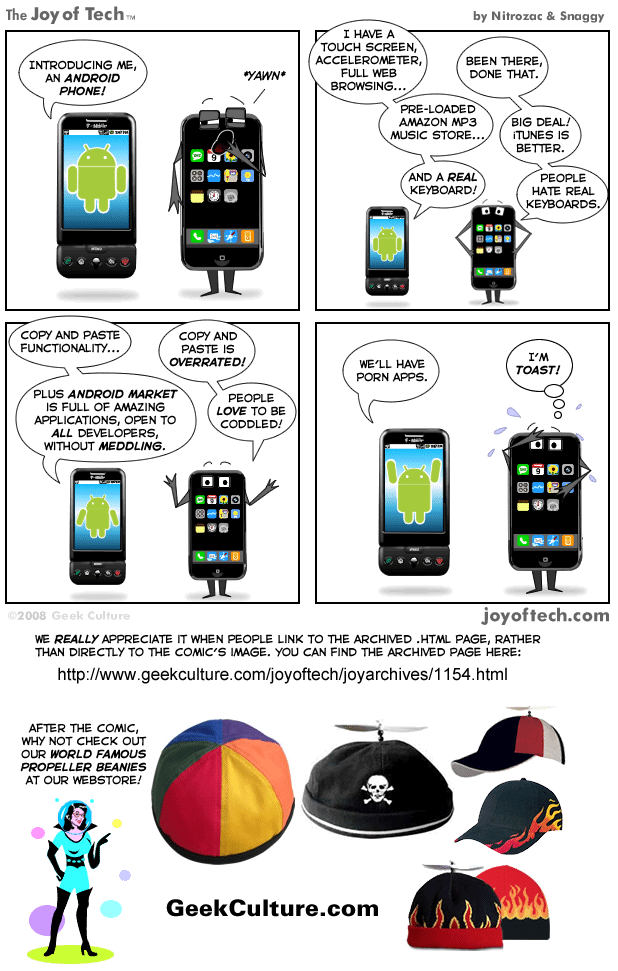
Cloud computing is a trap, warns GNU founder. According to RMS,

"It's stupidity. It's worse than stupidity: it's a marketing hype campaign,"

His comments are very similar to those made last week by Larry Ellison, the founder of Oracle, who criticized the rash of cloud computing announcements as
"fashion-driven" and "complete gibberish".

Well, given the recent posts and articles I've read on cloud computing, I have to agree with some of these statements. But I wouldn't be too paranoid either, since there are cost and productivity benefits involved. Especially RMS's stance on using local computers for all things is a bit unrealistic IMHO.

The problem with Cloud Computing is that it's a buzzword. You know what the problem with buzzwords is? All those marketing people and the like love them. They would Google and Wikipedia the crap out of those and come up with elaborate, one-sided theories on how the said 'buzzword' will increase ROI, Productivity and Reduce Global Warming. At the end of the day, just as Gartner's trusted hype cycle dictates, those who actually implement these technologies (Engineering) will decide where they actually stand. So it's refreshing to see people like Larry Ellison and RMS with good credibility airing their views to add balance.

Thinkpad :: Life after IBM

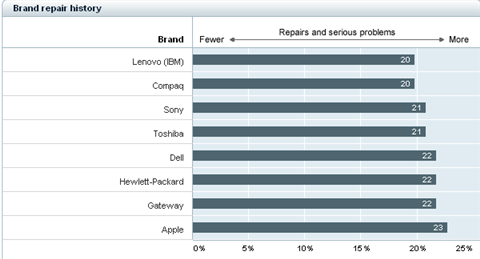
Gauging the ThinkPad: Before (IBM) and after (Lenovo) has some interesting thoughts on how the Laptop is faring these days. Now, I personally know a few die-hard fans of the old IBM ThinkPad who say the new one just doesn't live up to that standard. The IBM ThinkPad is a tough laptop, that I know. I have seen it survive 'incidents' where other laptops would just curl up and die. So the new one from Lenovo has big shoes to fill for sure.

But the most interesting thing in that post is the graph illustrating repair history for laptops tracked via a Consumer Reports survey from 2003 to 2007. According to that, Lenovo and Compaq are looking pretty good. My personal experience with Dell and HP is not very good. The HP I have is nearly 3 years old and on it's third LCD, second Motherboard and the battery died a few months back. I also have a Dell from work and this thing is on it's fourth battery. We all know Dell and their batteries, so this didn't come as a surprise.


Monday, September 29, 2008

The Biz School Chronicles - Week 01

Where: Lecture; Statistics for Management

What?:
"Data collected by a business become strategically irrelevant without proper statistical analysis."

Why?:
Imagine how much data is gathered by various systems on a daily basis. Apache server logs record each and every request made to your web site, Google Analytics, AdWords and similar solutions store detailed information about the time and money your business invests online and the visitors directed via these investments. But how often do you actually analyze this data and apply statistical techniques to them in order to derive valuable information? Information that will not only save money in the short term but shape the strategic decisions and investments you make on behalf of the company?


Where?:
Lecture; Financial and Management Accounting

What?:
"Sri Lankan accounting standards (SLAS) mandate that when preparing financial statements for a group of companies, IF any subsidiary under the parent company has shares owned by the said parent, amounting to more than 50% of the total shares, statements of both companies to be consolidated. "

Why?:
Shit like Enron will never happen here :) How? since the parent company is now legally required to show Balance Sheets for its subsidiaries (the ones it can manipulate because it has more than 50% stake in them), there is little chance to 'fake' profits by hiding debts and losses in those subsidiaries.


Those were the two most thought provoking things I walked away with this week ...


The Biz School Chronicles

.. would be the name of a new segment I'm adding to this blog from today.

When I graduated from the London Met' back in 2002, I promised myself I'll hang around in the industry long enough before deciding whether to pursue an MSc or an MBA. As it turned out this was a pretty good resolution on my part, since the past six years gave me a chance to work in some of the best software companies in Sri Lanka (among which is the first NASDAQ company in Sri Lankan history VRTU, where I worked for the most part).

Now, older and (hopefully) wiser, I made my choice and it is the MBA. This is simply because my industry (and most of you know how passionate I am when it comes to it) can use a few MBAs who've been in the trenches with scars to prove, than either MBAs with a 100% business background or Techies who 'think' they know business (unfortunately neither Google nor Wikipedia can tell us how to run a business my beloved bretheren).

So I'm back at school, as a part-time student and full-time software engineer (which is exactly the way I wanted it). Today was my first day and I'm already seeing return on investment (my hard earned money this time not my Father's, unlike 6 years ago. I love you amma and thaththa).

The Biz School Chronicles, will contain a little snippet of something I've learnt this week and how I think it matters. As always I'll keep it short and continue updates till I finish school (somewhere in the next two years).

The first snippet will arrive shortly ...

Saturday, September 27, 2008

FOSS; Europe gets it ...

Larry Augustin's Weblog: Commercial Open Source in Europe Verses the US is a nice side by side comparison of the perception of Free and Open Source Software in Europe and US.

Of the two, it seems like Europe's view of FOSS is both sincere, practical and can provide businesses sustainable long term ROI. The US view is mostly driven by cost and the Open nature doesn't play a significant role in the buying decision.

From the article's conclusions;
"I believe the European Open Source software community has moved beyond
that. The European community sees those benefits, but in addition
recognizes that the Open Source nature of the code is the driving
factor behind those benefits. As a result they have embraced Open
Source to a degree the US market has not;"

Google puts up a page on Yahoo ad agreement

Facts about the Yahoo-Google advertising agreement contains a 17 slide presentation on their ad deal with Yahoo along with quotes from advertisers and ad agencies. It also contains videos of Google Senior VP and Chief Legal Officer David Drummond explaining the deal at various occasions.
 
Excellent move.

Tuesday, September 23, 2008

Articles from the past

A reference to one of my past articles came up during a tea time chat today. But I couldn't easily get my hands on them since they were written more than 2 years ago (in 2006 to be precise). Now that I've found the links I thought I'd post them here for future reference.


These articles were among a bunch of stuff we came up with for an e-magazine named BabyTux Digest. Unfortunately it only saw one issue due to most of us getting distracted by other work.

If any of you are interested in reviving the magazine, drop me an e-mail or post a comment here. We decided to call it a day mainly due to our graphics genius going to Australia for studies. So if you are skilled in GIMP and other FOSS DTP software, the Sri Lankan FOSS community can use your talents right now :)

Scenes from India, our beloved neighbour

Scenes from India - The Big Picture - Boston.com
An eclectic collection of photographs highlighting the life and times in the sub continent from many angles including people, culture, conflict, religion, wildlife, nature and even fashion.

Monday, September 22, 2008

Tech firms fare better than most in jobs slump

Tech firms fare better than most in jobs slump - USNews.com: Nation and World: AP Article
Automakers and housing-related manufacturers were among those losing the most jobs during the month, while education, health and government saw job gains. But unlike in 2001, when a bust in the technology sector - accompanied by massive layoffs - played a central role in sparking a recession, this time around the industry is more insulated.
The article does have some valid points. But, I wonder how outsourcing will fare against the recent collapses. I know for a fact that Bear Sterns and Meryl Lynch outsourced a good portion of their software development, while companies like Fidelity reigns supreme in the portfolios of some leading outsourced service providers in this region. So the terminated projects will have a direct impact on the job market here.

On the other hand, tight budgets will eventually lead to more outsourcing, in which case there might be a boom, once the initial ripples have calmed down and CIOs start re-evaluating their strategies. Therefore less growth seems to be the order of the day for the moment, even for the outsourced service providers. But it would be wise for these companies to preserve their key staff for an eventual pick-up in business.